
Step-by-Step Guide to Open a Demat Account for Investing (Beginner’s Guide)
Are you planning to invest in the stock market but don’t know where to begin?
The very first step is to open a Demat account – it’s your digital locker for all your investments.
In this article, we’ll walk you through everything you need to know about a Demat account – what it is, why it’s important, and a step-by-step process to open one.
This guide is written in simple English, especially for first-time investors who want to understand things clearly.
📘 1. What is a Demat Account?
A Demat account (short for Dematerialized account) is a digital account used to hold your shares, mutual funds, bonds, and other securities in electronic form.
Earlier, investors received physical share certificates – pieces of paper that represented ownership in a company.
Managing them was difficult and risky. They could get lost, stolen, or damaged.
With a Demat account, all your investments are stored safely online.
You can buy, sell, and track your holdings with just a few clicks.
In simple terms:
- 🏧 Bank Account → Stores your money
- 📊 Demat Account → Stores your shares and investments
💡 2. Why Do You Need a Demat Account?
A Demat account is essential if you want to buy or sell shares in India.
Here’s why:
- ✅ Safe and Paperless: No risk of losing physical certificates.
- ⚡ Fast Transactions: Buying and selling shares takes seconds.
- 🔒 Secure Storage: Your investments are stored electronically with NSDL or CDSL.
- 📱 Easy Access: You can view or manage your portfolio anytime, anywhere.
- 🔁 Quick Settlement: The trade settlement process is faster and smoother.
In short, a Demat account is like your investment wallet — you can’t invest in stocks without it.
🏢 3. Who Provides a Demat Account?
In India, there are two main organizations (called depositories) that hold your shares:
- NSDL (National Securities Depository Limited)
- CDSL (Central Depository Services Limited)
However, you cannot open a Demat account directly with them.
You have to go through a Depository Participant (DP) — which can be a bank, stockbroker, or financial company authorized by these depositories.
Popular DPs (Brokers) in India:
- Zerodha (https://zerodha.com/open-account/)
- Groww (https://groww.in/open-demat-account)
- Upstox (https://upstox.com/open-demat-account/)
- Angel One (https://www.angelone.in/open-demat-account)
- ICICI Direct (https://www.icicidirect.com/open-a-demat-account)
- HDFC Securities (https://www.hdfcbank.com/personal/invest/demat/open-demat-account)
- Kotak Securities (https://www.kotaksecurities.com/open-demat-account/)
Each broker has different charges, platforms, and features, but the basic function remains the same — to hold and manage your investments.
- Documents Required to Open a Demat Account
Before you begin, keep these documents ready. You can upload them online easily.
✅ Mandatory Documents
- PAN Card – Compulsory for all investors
- Aadhaar Card – For identity and address proof
- Bank Proof – Cancelled cheque or passbook copy
- Passport-size Photograph – For profile verification
- Signature – Scanned copy on white paper
Having these documents handy will make the process smooth and quick.
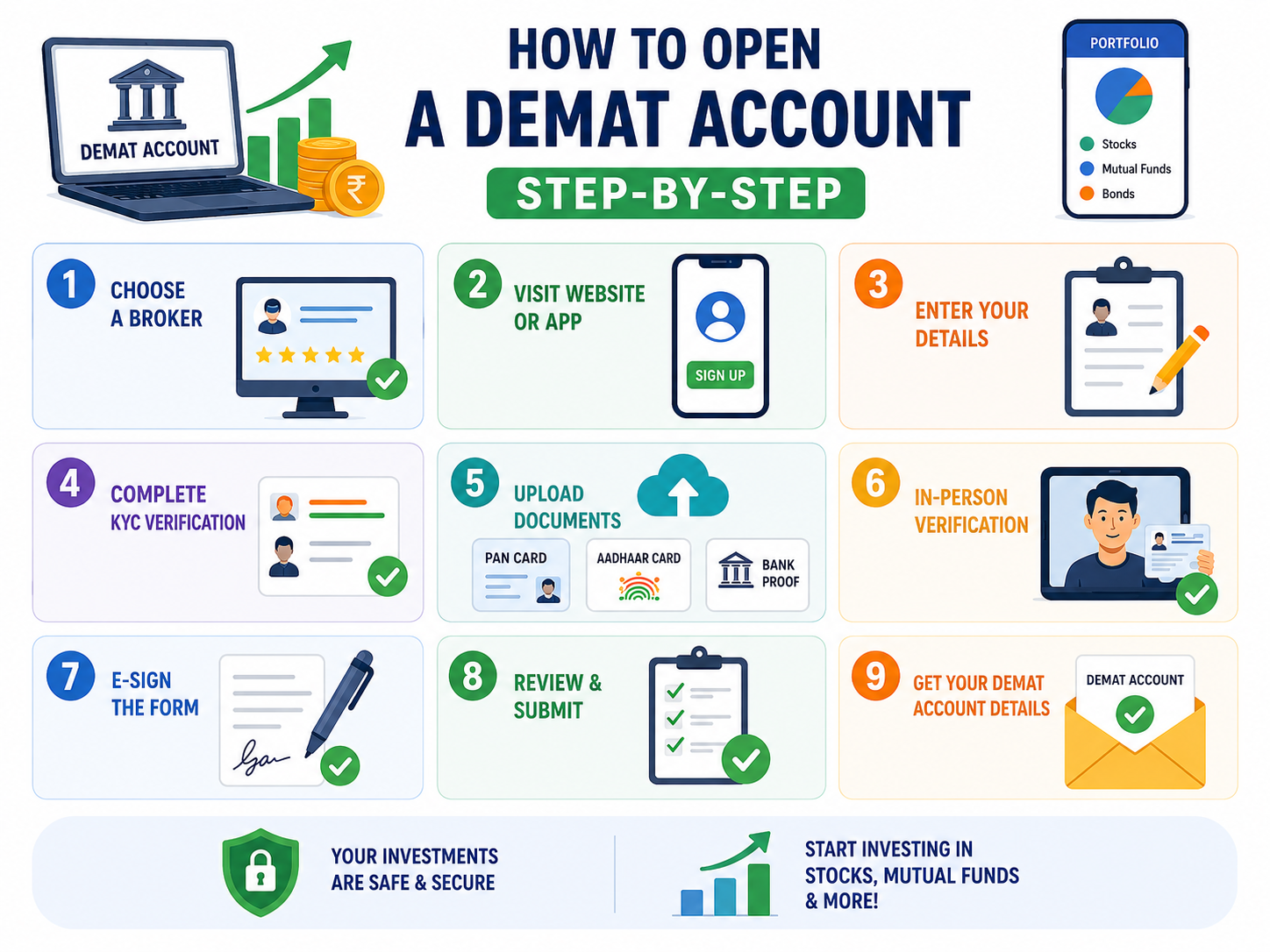
- Step-by-Step Process to Open a Demat Account Online
Let’s go through the complete process, one step at a time.
It usually takes 10–15 minutes to open an account online.
Step 1: Choose the Right Broker or Depository Participant
Your first decision is to choose a trusted broker (DP).
Compare the following before selecting:
- Account opening charges
- Annual maintenance charges (AMC)
- Brokerage fees per trade
- Trading platform features (mobile app/web interface)
- Customer service and reliability
💡 Tip: For beginners, platforms like Zerodha, Groww, or Upstox are popular because they are user-friendly and affordable.
Step 2: Visit the Broker’s Website or App
Go to the official website or download the broker’s app (from Play Store or App Store).
Click on “Open Demat Account” or “Sign Up”.
You’ll be asked to enter:
- Your mobile number
- Email ID
- PAN number
You’ll get an OTP on your phone or email for verification.
Step 3: Enter Your Personal Details
Now fill in your personal details:
- Full name (as per PAN)
- Date of birth
- Gender
- Address
- Bank details (account number, IFSC, branch)
Double-check your details — they must exactly match your documents.
Step 4: Complete KYC Verification
KYC means “Know Your Customer” — a compulsory verification step.
Most brokers allow online Aadhaar-based KYC.
You just need to:
- Enter your Aadhaar number.
- Verify via OTP sent to your Aadhaar-linked mobile.
- Confirm your auto-filled details.
This ensures that your identity and address are verified legally.
Step 5: Upload Your Documents
Now upload clear, readable copies of your:
- PAN card
- Aadhaar card
- Bank proof
- Signature
📸 Make sure the documents are not blurry or cropped.
If your details don’t match, your application might be delayed or rejected.
Step 6: In-Person Verification (IPV)
To confirm your identity, you may need to complete a quick In-Person Verification (IPV).
This is usually a short video where you:
- Show your face clearly
- Display your PAN card to the camera
- Read or confirm your name and date of birth aloud
This step takes only a few minutes and ensures your account security.
Step 7: E-Sign the Form
After filling out all details and uploading documents, you’ll be asked to e-sign the form using Aadhaar-based OTP.
You’ll receive an OTP on your Aadhaar-linked mobile number — enter it to confirm your digital signature.
Step 8: Review and Submit
Before submitting, review all your details:
- Name
- PAN
- Bank account number
- IFSC code
Once submitted, you’ll receive a confirmation email or message.
Your application will be processed by the broker and verified by NSDL or CDSL.
Step 9: Get Your Demat Account Details
After successful verification, you’ll receive:
- Client ID or BO ID (Beneficiary Owner ID)
- Demat Account Number
- Login credentials for your broker’s trading app or website
That’s it — your Demat account is now active! 🎉
You can start investing in shares, mutual funds, IPOs, ETFs, and more.
💰 6. Common Charges in a Demat Account
Even if opening the account is free, there may be a few small charges.
Type of Fee | Description | Typical Range |
Account Opening Fee | One-time setup charge | ₹0 – ₹500 |
Annual Maintenance Charge (AMC) | Yearly maintenance | ₹200 – ₹500/year |
Brokerage Fee | Charged per trade | Varies (flat or % based) |
Dematerialization Fee | For converting physical shares to electronic form | ₹10 – ₹50 per certificate |
Always check the fee schedule of your broker before opening an account.
📈 7. How to Use Your Demat Account After Opening
Once your account is active, here’s what you can do:
- Buy Stocks: Search a company and place a “Buy” order.
- Sell Stocks: Sell your holdings directly through the app.
- Track Portfolio: Monitor your profit/loss and portfolio performance.
- Add/Withdraw Funds: Link your bank account for smooth transactions.
- Invest in IPOs and Mutual Funds: Most brokers allow you to invest directly.
Note: Spend some time exploring the app to understand how it works.
🧠 8. Smart Tips for Beginners
- Start Small: Invest small amounts at first. Learn how buying and selling work.
- Avoid Following the Crowd: Don’t buy a stock just because everyone else is.
- Learn Before You Trade: Watch free tutorials and read financial blogs.
- Stay Updated: Follow company news and market trends.
- Think Long-Term: Real wealth is built by holding good companies for years.
⚠️ 9. Common Mistakes to Avoid
- Opening multiple Demat accounts unnecessarily.
- Ignoring AMC and letting your account become inactive.
- Trading based on rumors or social media tips.
- Using unofficial broker links — always go through verified websites.
- Forgetting to link your bank account properly.
- Avoid these errors to ensure a smooth and safe investing experience.
🏁 10. Final Thoughts
Opening a Demat account is the first and most important step in your investment journey.
The process is now 100% online, simple, and beginner-friendly.
With a few documents and a reliable broker, you can start investing in just minutes – from
your mobile or laptop.
Remember:
Take that first step today – open your Demat account, learn the basics of investing, and start building your financial future. 🌱
✅ Bonus Tips:
- Always open your Demat account through a registered and reputed broker.
- Avoid sharing your login details with anyone and enable two-factor authentication (2FA) for added security.
- Always use your Aadhaar-linked mobile number and email during registration. It simplifies OTP verification and future updates.